

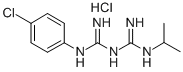
| 中文名称 | 吉非罗齐杂质A |
| 英文名称 | Chlorguanide Hydrochloride |
| CAS号 | 637-32-1 |
| 分子式 | C11H17Cl2N5 |
| 分子量 | 290.19 |
| EINECS号 | 211-283-7 |
| 熔点 | 249-2510C |
| 溶解度 | 乙腈:水:~1mg/mL(60/40) |
| 形态 | 固体 |
| 危险品标志 | T |
| 危险类别码 | 25 |
| 安全说明 | 45 |
| 危险品运输编号 | 3249 |
| WGK Germany | 3 |
| RTECS号 | DU1750000 |
| 海关编码 | 2925294500 |
| 危险等级 | 6.1(b) |
| 包装类别 | III |
| 毒性 | LD50 orally in rats: 200 mg/kg (Schmidt) |
Proguanil per se has only weak antimalarial activity
in vitro
(IC
50
=2.4-19 μM), and its effectiveness depends on the active metabolite Cycloguanil (IC
50
=0.5-2.5 nM). The Cycloguanil is a dihydrofolate reductase (DHFR) inhibitor. The combination of Atovaquone and Proguanil is synergistic
in vitro
. Both drugs also have activity against gametocytes and pre-erythrocytic (hepatic) stages of malaria parasites.
Proguanil acts as a biguanide rather than as its metabolite Cycloguanil (a parasite dihydrofolate reductase [DHFR] inhibitor) to enhance the Atovaquone effect. Proguanil-mediated enhancement is specific for Atovaquone, since the effects of other mitochondrial electron transport inhibitors, such as Myxothiazole and Antimycin, are not altered by inclusion of Proguanil.
5-HT
3
receptor responses are reversibly inhibited by Proguanil, the metabolite 4-chlorophenyl-1-biguanide (CPB) and the active metabolite Cycloguanil (CG), with an IC
50
of 1.81, 1.48 and 4.36 μM, respectively.
Proguanil (p.o.; 2.9 mg/kg body weight; daily for 5 days and 6 weeks respectively) shows mild degenerative changes for five days, while shows severe degenerative changes for six weeks in wistar strain albino rats.
Serum testosterone level is significantly decreased for proguanil treatment rats.
Administration of Malarone (Atovaquone and Proguanil) to experimentally
B. gibsoni
infected two dogs in chronic stage and three dogs in acute stage results in decrease in parasitemia, and clinical improvements are observed.
-
CAS号:44830-55-9
氯胍杂质A -
CAS号:537-21-3
氯丙胍 -
CAS号:13590-98-2
氯胍相关物质C -
CAS号:102767-28-2
左乙拉西坦 , 一种选择性M2毒蕈碱乙酰胆碱受体(mAChR)抑制剂. 可抗癫痫 -
CAS号:637-32-1
吉非罗齐杂质A -
CAS号:35708-82-8
氯胍相关物质D -
CAS号:1071546-52-5
氯胍相关物质G -
CAS号:500-92-5
氯胍 -
CAS号:4022-81-5
1-(4-氯苯基)双胍盐酸盐 -
CAS号:25812-30-0
吉非罗齐 -
CAS号:44830-55-9
氯胍杂质A -
CAS号:537-21-3
氯丙胍 -
CAS号:13590-98-2
氯胍相关物质C -
CAS号:102767-28-2
左乙拉西坦 , 一种选择性M2毒蕈碱乙酰胆碱受体(mAChR)抑制剂. 可抗癫痫 -
CAS号:637-32-1
吉非罗齐杂质A -
CAS号:35708-82-8
氯胍相关物质D -
CAS号:1071546-52-5
氯胍相关物质G -
CAS号:500-92-5
氯胍 -
CAS号:4022-81-5
1-(4-氯苯基)双胍盐酸盐 -
CAS号:25812-30-0
吉非罗齐