

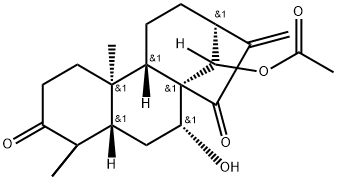
| 中文名称 | 蓝萼乙素 |
| 英文名称 | glaucocalyxin B |
| CAS号 | 80508-81-2 |
| 分子式 | C22H30O5 |
| 分子量 | 374.48 |
| EINECS号 | 200-589-5 |
| 熔点 | 190.5-191℃ |
| 沸点 | 509.1±50.0 °C(Predicted) |
| 密度 | 1.21±0.1 g/cm3(Predicted) |
| 溶解度 | 溶于二甲基亚砜 |
| 形态 | 固体 |
| 酸度系数(pKa) | 13.42±0.70(Predicted) |
| 颜色 | 白色至米白色 |
IC50: 5.86 μM (HL-60 cell Growth)
Glaucocalyxin A (GlnA) and (GlnB) dose-dependently decrease the growth of HL-60 cells with an IC 50 of approximately 6.15 and 5.86 µM at 24 h, respectively. Both Gln A and B could induce apoptosis, G2/M-phase cycle arrest, DNA damage and the accumulation of reactive oxygen species (ROS) in HL-60 cells. GlnB inhibits the proliferation of human cervical cancer cells in vitro through the induction of apoptosis andautophagy, which may be mediated by the phosphatidylinositol 4,5 bisphosphate 3 kinase/Akt signaling pathway. Treatment with GlnB inhibits the proliferation of HeLa and SiHa cervical cancer cell lines in a dose dependent manner. GlnB increases the apoptotic cell population of and enhanced poly (ADP ribose) polymerase 1 cleavage. GlnB also induces increased light chain 3 II/I protein cleavage, indicating the induction of autophagy. GlnB treatment increases the expression of phosphatase and tensin homolog and decreases the expression of phosphorylated protein kinase B. Glaucocalyxin B (GLB), one of five ent-kauranoid diterpenoids, significantly decreased the generation of nitric oxide (NO), tumor necrosis factor (TNF)-α, interleukin (IL)-1β, cyclooxygenase (COX)-2 and inducible nitric oxide synthase (iNOS) in the lipopolysaccharide (LPS)-activated microglia cells.
-
CAS号:4871-97-0
姜黄醇 -
CAS号:19431-84-6
莪术烯醇 -
CAS号:20493-56-5
莪术呋喃烯酮 -
CAS号:13657-68-6
莪术二酮 -
CAS号:79498-31-0
蓝萼甲素 -
CAS号:24268-41-5
莪术呋喃二烯酮 -
CAS号:87-44-5
反式石竹烯 -
CAS号:71963-77-4
蒿甲醚(标准品) -
CAS号:84745-95-9
毛萼乙素 -
CAS号:473-15-4
β-桉叶醇 -
CAS号:17910-09-7
莪术烯 -
CAS号:164991-67-7
地骨皮乙素 -
CAS号:27740-01-8
野黄芩苷 -
CAS号:473-08-5
α-香附酮 -
CAS号:4871-97-0
姜黄醇 -
CAS号:19431-84-6
莪术烯醇 -
CAS号:20493-56-5
莪术呋喃烯酮 -
CAS号:13657-68-6
莪术二酮 -
CAS号:79498-31-0
蓝萼甲素 -
CAS号:24268-41-5
莪术呋喃二烯酮 -
CAS号:87-44-5
反式石竹烯 -
CAS号:71963-77-4
蒿甲醚(标准品) -
CAS号:84745-95-9
毛萼乙素 -
CAS号:473-15-4
β-桉叶醇 -
CAS号:17910-09-7
莪术烯 -
CAS号:164991-67-7
地骨皮乙素 -
CAS号:27740-01-8
野黄芩苷 -
CAS号:473-08-5
α-香附酮